Reinforced concrete with smooth surfaces – from the 3D printer.
Concrete components produced by 3D printing are typically identifiable by their ribbed surfaces.
Current materials and processes almost inevitably result in this.
Our printing process enables the 3D printing of concrete components, including reinforcement and smooth surfaces.
Our goal is the production of structurally calculable concrete components that integrate seamlessly into the desired on-site design.
This requires smooth surfaces.
The fact that components are produced by a 3D printer offers advantages in many respects.
However, the primary focus is on the component's functionality and economic efficiency.
New and globally unique
Established 3D printing processes have evolved slowly in recent years.
From our perspective, this is partly due to the continuous search, development, and use of materials that are 'printable' with conventional methods.
Greater progress can be achieved if we develop processes that enable the use of conventional materials in 3D printing.
If a component can be printed from reinforced, conventional concrete, it is structurally calculable.
3D printing of multiple, fluid, non-self-supporting materials in a single pass
We have developed a process that allows allows conventional materials to be printed – which were previously unsuitable for 3D printing.
With this process, it is possible to print multiple materials simultaneously in a single pass.
Reinforcement can also be integrated during the printing process.
For example, it becomes possible to print components from conventional concrete, including insulation, reinforcement, and conduits, in a single pass.
The Technical Process
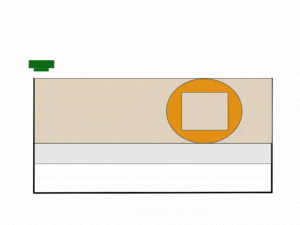
- In this animation, a simple example component is printed – a concrete sphere with a cubic cavity.
Moist sand is used as support material. - Printing is performed layer by layer within a closed build chamber featuring a retractable base.
- Each printed layer fills the entire build chamber before the base is lowered by one layer thickness.
- Various building and support materials can be printed in the same pass, either from multiple nozzles or with multiple print heads.
- Once the component has cured, the support material is removed, e.g., by washing out.
Differences from Other 3D Printing Processes
- Printing of non-self-supporting, fluid materials.
- Printing of multiple materials simultaneously.
- Integration of reinforcement during the printing process
(e.g., steel when printing concrete components). - The printing devices scale from very small to very large. The same applies to layer thicknesses.
Both are determined by the components to be produced.
Materials / Applications
- Conventional, reinforced concrete with insulation and conduits
Production of precast concrete elements that are difficult or impossible to form. - Sand casting molds with embedded wax/foam models and optionally a sand core.
- Cartilage, bone, and tissue in the medical field – Prosthetics.
- Teeth and Dental Prosthetics
Seeking Visionaries for Implementation
We are convinced by our process and the necessary devices.
Both the process and the devices are protected by patent in the most important European countries and also in the USA.
For implementation, we are seeking partners capable of setting up and operating such facilities themselves, or of marketing them.
Entrepreneurs who wish to utilize our processes and devices in their own operations (licensees) are also most welcome.
Has this sparked your interest?
Then please contact us:
Use our contact form
or send us an email to: kontakt@3d-mmp.at